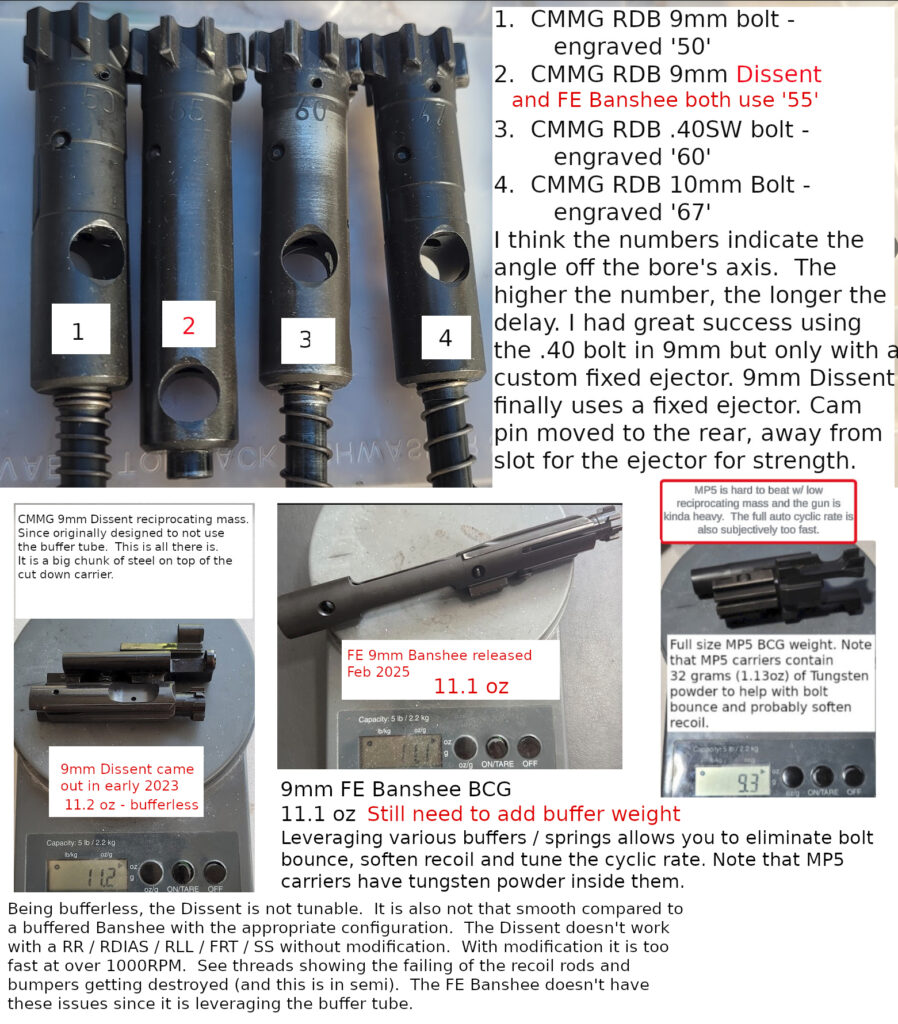
Competition shooters have been running lightened carriers for decades so this is nothing new. Many opinions on this that you can research for yourself and many of those opinions apply here so I won’t dwell on all those points. Rather, I want to discuss why for this particular system. The picture below has a lot going on. At the top, I’m trying illustrate the different angles used on the bolts to control the delay on the CMMG RDB system. When discussing 9mm, it is my understanding that the first CMMG 9mm ‘Guard’ (Original name and later changed to Banshee) were using unmarked 45 degree bolts. They later changed to 50 degree bolts and also marked them as such. These all used the spring loaded ejectors which IMHO, are prone to failure and unreliable.
Then in 2023 the bufferless Dissent was released finally with a fixed ejector. Being bufferless, there is less reciprocating mass and they increased the angle to now 55 degrees. I saved the screenshot below from 2018 where CMMG posted about the possibility of offering bolts with different angles for 9mm and other than what I discussed above, this was never done.
Think of the MP5 with it’s different locking pieces. 100 degree for full size, 80 degree for suppressed K and 120 degree for the SD. I think this should exist for the CMMG RDB but it doesn’t. I believe due to cost and having to support and educate customers. So what are the options? CMMG offered their tuning kit consisting of 3 different weights you can add to the carrier to add mass to the problem. That was OK for the old 50 degree bolt but now with the 55 degree bolt most people need to remove mass not add mass. Bear in mind, I’m not saying this is required. Many people can get reliability by choosing the combination that works for them meaning ammo, spring, buffer and suppressor if applicable. I do however, believe that lightening the carrier does give you more options. You can see in my picture below that I had used a 40SW (60 degree) bolt for running 9mm but that is no longer an option with the FE Banshee bolt since the cam pin hole has been moved more to the rear to clear the fixed ejector. The 60 degree worked great for me for suppressed usage but it wouldn’t run without a can mounted. So when I did my ‘PhaseII’ to use the buffer tube I was optimistic that it would work great with the 55 degree bolt and it does. However, I did anticipate that people not using a can with weak ammo may have reliability issues with this 55 degree bolt and full weight carrier vs the old 50 degree and we see posts reflecting that today. We also see posts about people using ported suppressed barrels not running unless using weaker buffer springs and LW 3oz buffers.

I have a customer with a BRT integrally suppressed barrel. BRT recommends using the yellow Sprinco (reduced power) buffer spring and a 3oz buffer. Yes that works but what also works is using my favorite setup (ARS / ARS-EX) Tubb LW spring or Neverwear Warthog spring and my favorite Kynshot RB5007 hydraulic buffer (5.9oz) and a lightened carrier. It is not reliable if the carrier is not lightened. So in this example, we are removing 2 oz of ‘dead’ mass from the carrier and ‘moving’ it to the hydraulic buffer body that is ‘live’ mass. That live mass moves forward upon the initial recoil impulse spreading it over time.
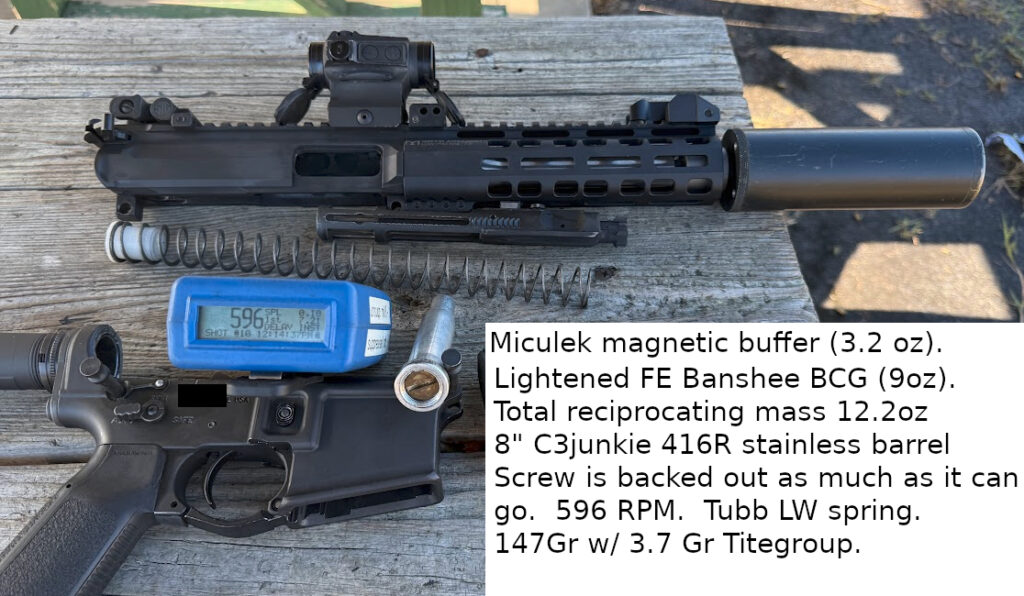
By removing mass from the carrier you now have more buffer choices to choose from. Or stay wth a LW 3oz buffer to keep your total reciprocating mass low. At 12.2 oz pictured below is currently the lowest amount of reciprocating mass I have seen on any 9mm AR variant on the market and still yielding slow full auto cyclic rates.